


Table of Contents
- Why Renovation Budget Blowouts Happen (and How to Spot Them Early)
- What Renovation Contingency Budget Percentage Should You Set?
- Common Renovation Hidden Costs That Blow Your Budget
- Managing Renovation Variations Without Losing Control
- How to Read a Building Contract Before You Sign
- Digital Tools for Tracking Your Renovation Budget
- Post-Renovation Hidden Costs Most Homeowners Miss
- Conclusion
- Frequently Asked Questions
Last Updated: September 29, 2026
Why Renovation Budget Blowouts Happen (and How to Spot Them Early)
Learning how to avoid renovation budget blowouts starts with understanding that most overruns are not bad luck. They are predictable. Learning how to avoid renovation budget blowouts starts with understanding that most overruns are not bad luck. They are predictable. Planning is the single biggest lever you control. Planning is the single biggest lever you control.
The Psychological Triggers Behind Overspending
Decision fatigue is the quiet culprit. By the time you have chosen tiles, tapware, paint and door handles, your judgement is depleted, and that is exactly when you agree to an upgrade you never budgeted for. The “while we’re at it” trap follows close behind: once a wall is open, saying yes feels cheaper than saying no.
Supply Chain and Material Cost Volatility
Material costs move. Timber, steel and imported fittings can shift between quote and delivery, which is why a fixed-price contract with locked supply terms protects you better than a handshake estimate. Ask your builder how they handle price escalation and who carries the risk if a supplier changes terms mid-project.
What Renovation Contingency Budget Percentage Should You Set?
Set your renovation contingency budget percentage at 15 to 20 per cent of the total build cost for a period home, and never below 10 per cent for a straightforward modern renovation. This buffer is not spare cash. It is the fund that absorbs what you cannot see yet.
Treating your contingency as a shopping fund is the most common mistake. The moment you spend it on upgraded finishes, you have no reserve for the structural problem you have not found yet.
Common Renovation Hidden Costs That Blow Your Budget
The most common renovation hidden costs sit behind walls, under floors and above ceilings. A builder and homeowner examining exposed timber framing and structural elements behind a removed wall in a period weatherboard home, with tools and a clipboard nearby, is a scene every renovator should expect at least once.
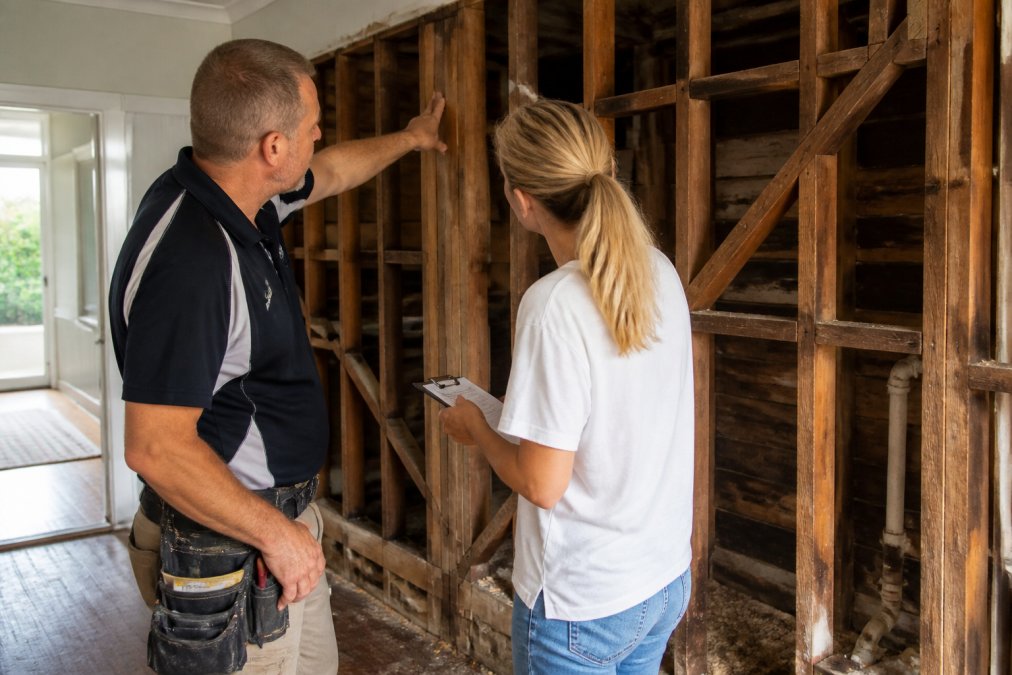
What’s Behind the Walls and Under the Floors
Hidden structural issues are the classic budget killer, and the reason is sequencing. A discovery behind a wall is rarely a standalone cost. It forces a chain: strip out, make safe, engineer, rectify, re-line, re-finish. Each link is a separate trade, a separate invoice and a separate delay, and delays carry their own cost in extended hire of scaffolding, temporary accommodation or lost rental income.
- Rotten or undersized framing, often hidden behind plaster, and only visible once linings are removed.
- Asbestos-containing materials, commonly in eaves, roof sheeting, backing boards and old vinyl. Removal must be done by a licensed removalist and disposed of at an approved facility, and the cost scales with the volume and accessibility of the material.
- Outdated electrical wiring, rubber-insulated or cloth-wrapped cable, or circuits with no safety switch protection. Bringing a circuit up to current standards often means a new switchboard, not a patch.
- Failed plumbing and drainage, galvanised pipe, cracked earthenware drains or illegal stormwater connections.
- Water damage and mould, usually traced back to a roof or shower leak that has been running for years.
- Non-compliant previous work, a DIY extension, an unapproved carport, or a bathroom built without waterproofing. You inherit the liability.
- Council-required reports, structural engineering, geotechnical assessment or a building surveyor’s inspection, each of which is a cost before any rectification begins.
Why These Costs Blow the Budget
The mechanism is simple. Hidden costs are not in the contract, so they are not in the contingency line either. They arrive as a variation order, and a variation order is priced at the builder’s rate for that trade, not at the rate you would have negotiated if the work had been in the original scope.
How to Reduce the Risk Before You Start
You cannot eliminate hidden costs, but you can shrink them:
- Commission a building inspection and, where relevant, a pest inspection before you finalise the scope. A pre-purchase or pre-renovation report is cheap relative to what it can reveal.
- Open a wall or floor in one representative area during the design phase. A small exploratory opening, made good afterwards, gives your builder real information to price against.
- Ask your builder to price the likely discoveries as provisional sum items, so the rate is agreed before the work is needed.
- For period homes, assume at least one significant structural or services discovery. That assumption belongs in your contingency, not in your optimism.
A low fixed price on a period home is not a bargain. It usually means the builder has priced only what is visible, and every discovery will arrive as a variation at a rate you did not negotiate.
The Post-Discovery Conversation
When a hidden cost appears, ask three questions before agreeing to anything: what is the minimum compliant fix, what is the cost and time impact, and what happens if we defer it. Sometimes the answer is that the work must be done now because it is structural or safety-related. Sometimes it can be staged. Either way, get the answer in writing and update your running budget the same day.
Managing Renovation Variations Without Losing Control
Managing renovation variations is where discipline separates a controlled project from a runaway one. A variation order is any change to the agreed scope of work, and every one should be documented, priced and signed before the work proceeds.
How to Read a Building Contract Before You Sign
A building contract is the document that decides who pays when something goes wrong, so read it before you sign, not after. Focus on four things: the scope of work, the payment schedule, the variation process, and the dispute resolution clause.
Compare the allowance figures in your contract against real supplier prices before you sign. A builder who has underquoted allowances is either inexperienced or setting up a variation later.
Digital Tools for Tracking Your Renovation Budget
Most renovation budget guides tell you to ‘keep a spreadsheet’ and stop there. That is the gap this section fills. A spreadsheet only prevents a blowout if it is structured to show you the number that matters: your true remaining balance, including committed costs you have not yet paid.
The Four Columns That Actually Matter
A renovation budget tracker needs four columns, not two:
| Column | What it holds |
|---|---|
| Original budget | The contract sum plus your own allowances for items you are supplying |
| Approved variations | Every signed variation order, added as a separate line |
| Committed cost | Work ordered or materials purchased but not yet invoiced |
| Actual paid | Invoices received and paid |
The critical column is committed cost. A budget that only tracks what you have paid will always look healthier than it is, because the expensive work is usually ordered weeks before it is invoiced. Track committed cost and you see the blowout forming while you can still act.
A Simple Structure You Can Build Today
Set up one tab per cost category, demolition, structural, services, wet areas, kitchen, finishes, external works, professional fees, and one summary tab that pulls the totals. On the summary tab, calculate:
- Contingency remaining = original contingency minus approved variations
- Forecast final cost = original budget plus approved variations plus a realistic estimate of known-but-unpriced items
- Variance = forecast final cost minus original budget
Tools That Do the Job
You do not need specialist construction software for a single renovation. The practical options are:
- A cloud spreadsheet (Google Sheets, Microsoft Excel online), free, shareable with your builder, and versioned so you can see what changed. This is the right choice for most homeowners.
- Cloud accounting apps such as Xero or QuickBooks, useful if you are running the project as an owner-builder and need GST and invoice records in one place.
- Shared project folders (Google Drive, Dropbox), for storing quotes, variation orders, invoices and photos against the relevant milestone.
- A dedicated renovation or build-tracking app, convenient for photos and progress notes, but usually weaker than a spreadsheet for the committed-cost calculation that actually protects your budget.
The Discipline That Makes It Work
Three habits turn a tracker into a control:
- Photograph every invoice and variation order the day you receive it, and file it against the milestone. This gives you a written record if a dispute arises.
- Reconcile the tracker against your builder’s progress claim before you pay it. If the claim does not match your record, ask why in writing.
- Review the variance line every week, not every month. A variance of a few per cent is normal. A variance that is growing week on week is a signal to pause and reassess scope.
Share the summary tab with your builder. A builder who can see the same numbers you can is far less likely to present a surprise variation, and far more likely to flag a cost risk early.
What to Do When the Tracker Shows Trouble
If your forecast final cost exceeds your original budget by more than your remaining contingency, you have three levers: reduce scope, defer non-essential work to a later stage, or increase the budget. Choose deliberately and in writing. The one option that reliably makes things worse is to keep going and hope the numbers improve.
Post-Renovation Hidden Costs Most Homeowners Miss
The build finishing is not the budget finishing. Post-renovation costs catch people out because they feel like they should be free. They are not.
Budget for:
- Landscaping and reinstating gardens disturbed by trades
- A deep clean and rubbish removal
- New furniture or window furnishings for the expanded space
- Increased insurance premiums for a higher-value home
- Minor defects and adjustments in the first months of use
Conclusion
A renovation budget rarely fails in one dramatic moment. It erodes through undocumented changes, optimistic allowances and surprises behind the walls. The fix is unglamorous: a realistic contingency fund, a documented scope of work, a contract you actually understand, and a builder who keeps you informed at every milestone.
Frequently Asked Questions
What is the most common cause of renovation budget blowouts?
Hidden structural issues discovered once work begins are the leading cause. In period and weatherboard homes, removing walls or floors often reveals damaged stumps, outdated wiring, asbestos or water damage that wasn’t visible during inspection. These surprises require immediate decisions and extra trades, pushing costs beyond the original renovation budget. A thorough pre-construction inspection and a healthy contingency fund are your best protection against this.
What renovation contingency budget percentage should I set?
Most builders recommend setting aside 10 to 20 percent of your total project cost as a contingency fund. For older period homes where hidden issues are more likely, aim for the higher end, around 20 percent. This buffer covers unexpected structural repairs, material price increases or design changes you decide on mid-project. If you don’t use it, you have leftover funds for finishing touches or a welcome buffer against post-renovation costs.
How do I handle managing renovation variations without losing control?
Insist on a written variation order before any extra work begins. Each variation should detail the scope of work, the cost, and the timeline impact. Review every variation against your original scope of work and contingency fund. If variations are stacking up, pause and reassess your budget allocation. A builder who documents variations properly and communicates early makes managing renovation variations far less stressful for everyone involved.
What should I look for in a fixed-price building contract?
Check that the contract clearly defines the scope of work, includes architectural drawings and specifications, lists all allowances for fixtures and finishes, and states what triggers a variation. Look for the deposit amount, progress payment schedule, and completion date. Under Australian consumer law, residential building contracts must comply with state regulations, so confirm your builder is licensed and the contract meets those standards before signing.
How can I keep costs down when renovating an older home?
Get a thorough site inspection and building report before you finalise your design. Engage a quantity surveyor early for accurate cost estimation, and use a fixed-price contract where possible. Avoid changing your mind once construction starts, as every design change becomes a variation order. Prioritise structural integrity and compliance standards first, then allocate remaining renovation budget to cosmetic finishes you can upgrade later.
What are common renovation hidden costs I should plan for?
Common renovation hidden costs include asbestos removal, structural repairs behind walls, upgrading outdated electrical wiring or plumbing to meet current building regulations, council permit fees, and site clean-up. Post-renovation, you may also face increased insurance premiums, higher council rates if your property value rises, and landscaping repairs from heavy machinery access. Budgeting for these from the start prevents nasty surprises.

